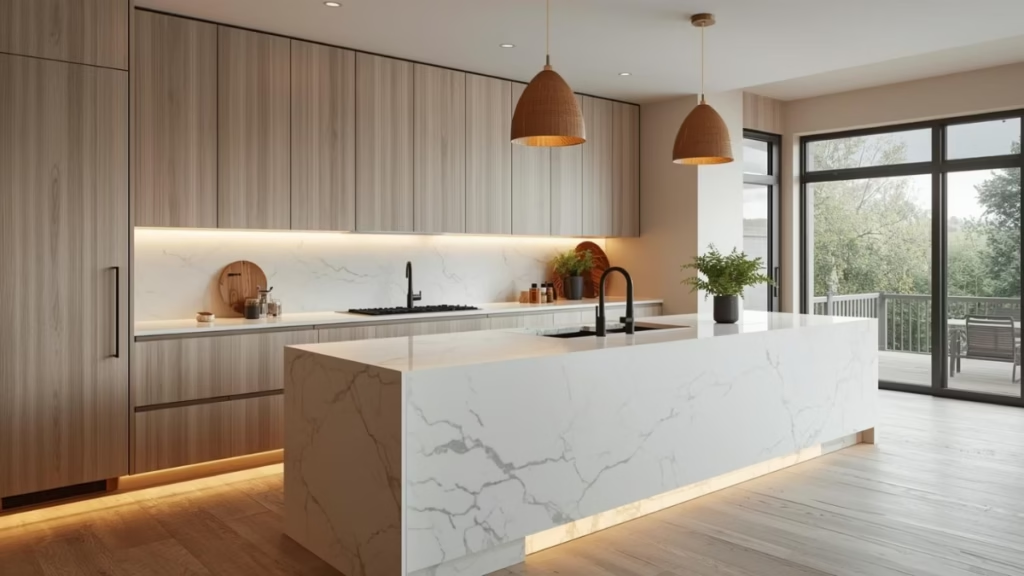
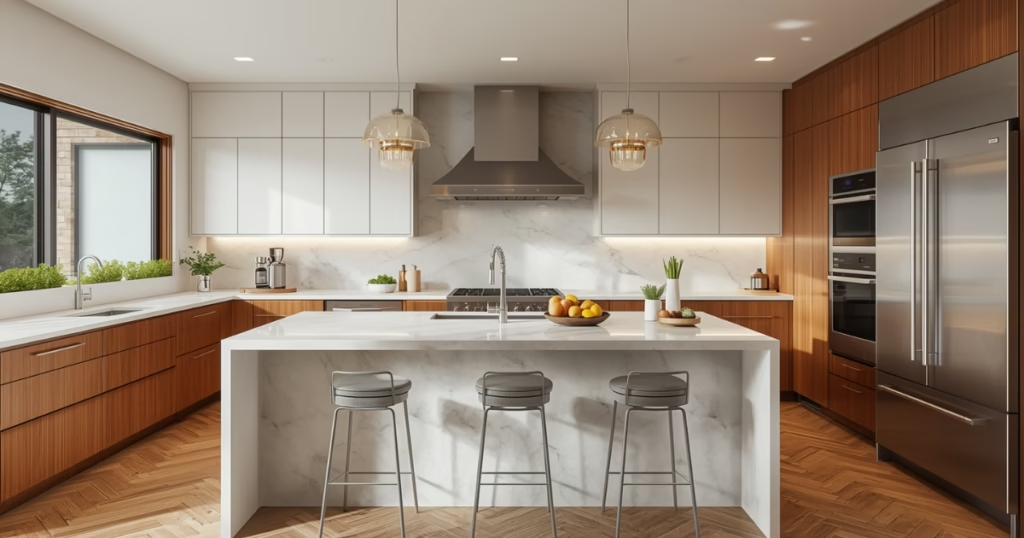
10 Modern Kitchen Countertop Ideas That Are Worth the Investment
The countertop is one of the most touched surfaces in your home. It needs to look right, work hard, and hold up for years. These 10 ideas cover materials that do all three.
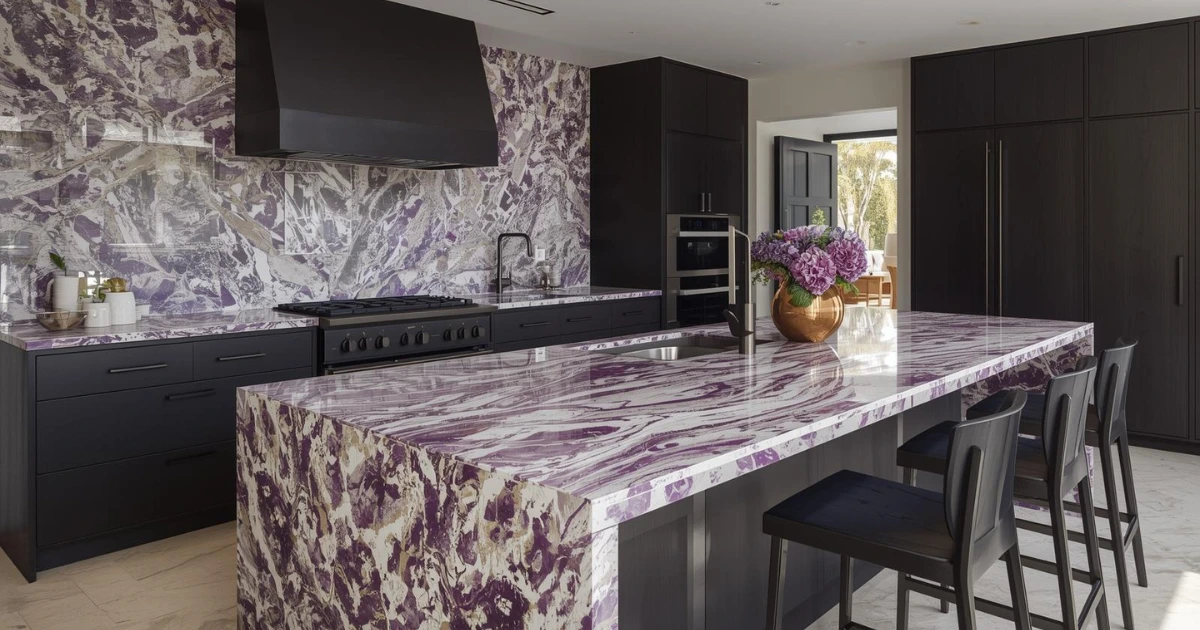
Countertops take up a significant chunk of any kitchen renovation budget. They also take up a significant chunk of the kitchen’s visual field. Both of those facts mean the decision deserves more than a quick showroom visit.
The right countertop depends on how you actually cook, not how you imagine you cook. A beautiful marble surface that stresses you out every time someone sets a wine glass down is the wrong choice, regardless of how good it looks in photos.
We have covered 10 materials that are genuinely worth considering in 2026. For each one, we give you the honest version: what it looks like, what it is like to live with, and what it costs.
Stone & Stone-Effect Countertops
Ideas 1–7Quartz: The Sensible Choice That Still Looks Great
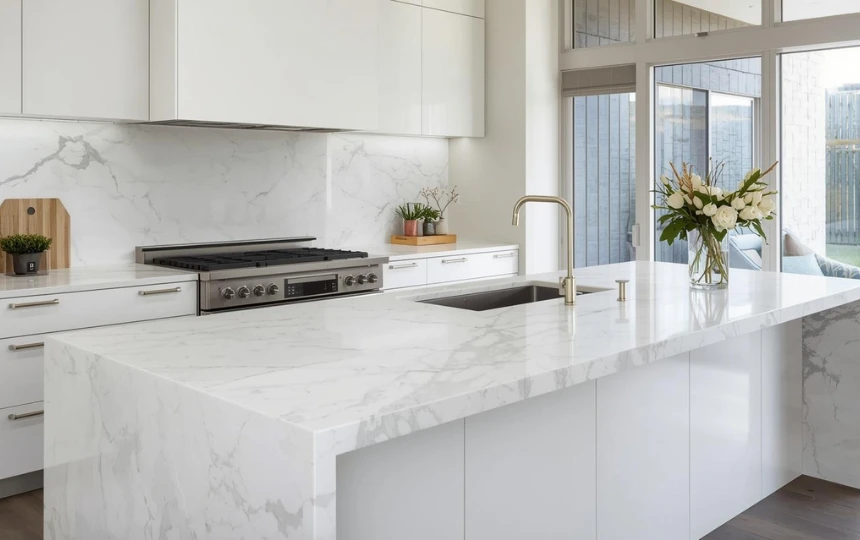
Quartz is the most popular kitchen countertop material in the world right now, and it has earned that position honestly.
It is engineered from crushed quartz stone bound with resin, which makes it non-porous, heat-resistant, scratch-resistant, and completely maintenance-free. No sealing, no special cleaners, no annual treatments. Wipe it down and move on.
The visual range is enormous. Brands like Caesarstone, Silestone, and Cambria produce everything from pure white slabs to dramatically veined marble-effect surfaces to concrete-look finishes. The veining in premium quartz has improved dramatically in recent years. The best versions are genuinely difficult to distinguish from natural stone at normal viewing distance.
Cost runs from around $55 to $150 per square foot installed. The variation comes from the specific product, the edge profile, and the complexity of the layout. For most kitchens, quartz offers the best balance of aesthetics, durability, and value on this list.
Honed Marble: Beautiful, High-Maintenance, Worth It for the Right Kitchen
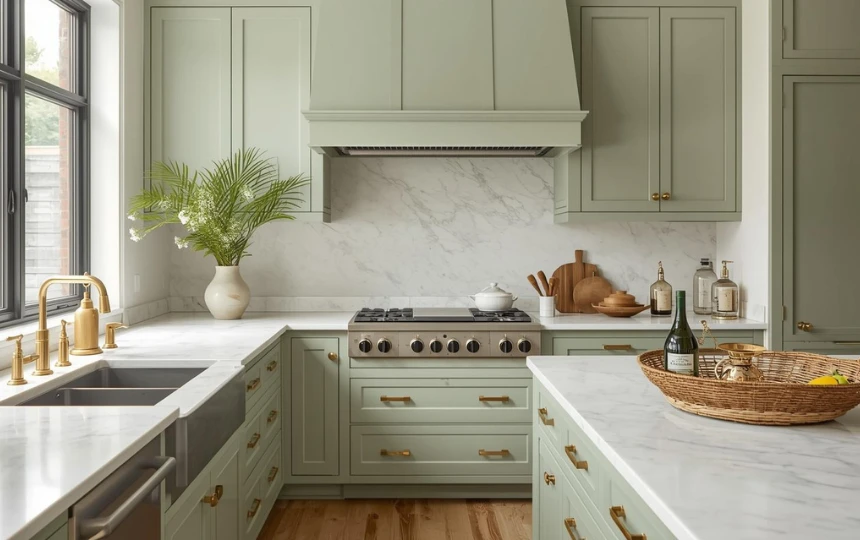
Nothing looks like marble. Not quartz, not porcelain, not anything else. When you are standing in a kitchen with genuine honed Carrara or Calacatta marble, you know it immediately. There is a quality to the material that manufactured alternatives cannot fully replicate.
The honest trade-off: marble etches. Acidic liquids (lemon juice, wine, coffee, vinegar) leave dull marks on the surface. These are not stains. They are chemical reactions between the acid and the calcium carbonate in the stone. Honed marble is more forgiving than polished because the matte surface absorbs the etching into its texture rather than leaving a visible shiny patch on a glossy surface.
For kitchens that see moderate use and belong to homeowners who are genuinely at peace with a surface that develops a patina over time, marble is a deeply satisfying choice. For high-traffic family kitchens with young children and heavy daily use, the maintenance burden becomes genuinely stressful.
Seal annually with a quality penetrating sealer. Clean spills promptly. Accept the patina as part of the material’s character. Budget $75 to $250 per square foot installed depending on the marble variety.
Quartzite: Natural Stone That Actually Holds Up
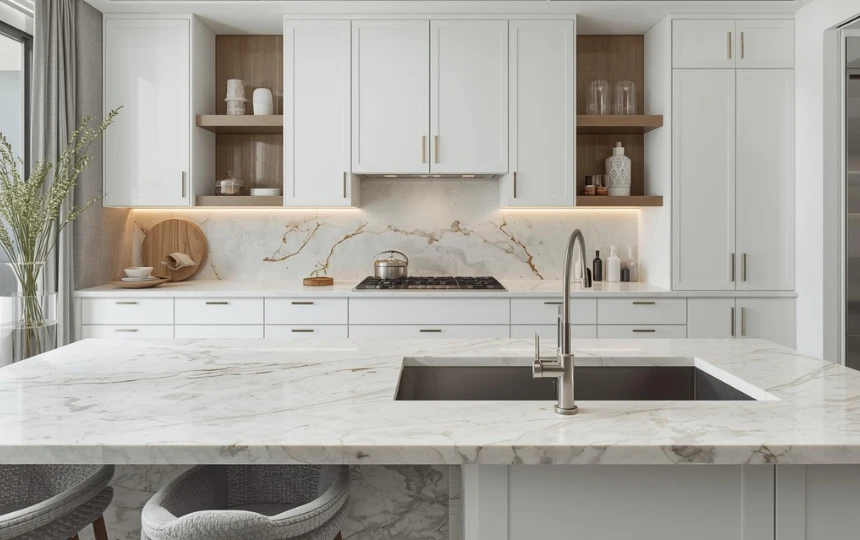
Quartzite is not quartz. It is a naturally occurring metamorphic rock, formed when sandstone is subjected to heat and pressure. It looks similar to marble, which causes enormous confusion in showrooms. It is significantly harder and more durable.
Unlike marble, quartzite does not etch with acidic liquids. It is harder than granite. It has a natural stone character that quartz cannot match. And in varieties like Taj Mahal, Super White, and Calacatta Viola, it offers some of the most dramatic and beautiful surfaces available for kitchen countertops.
It does require sealing once or twice a year, which marble also requires. And it is genuinely porous, so spills need to be wiped promptly. But for homeowners who want the look and feel of natural stone without marble’s vulnerability to etching, quartzite is the most compelling alternative on the market.
Cost ranges from $75 to $200 per square foot installed for standard varieties. Premium or rare quartzites can reach $300 or more. The slab-selection process matters here. Always view the actual slab you are buying, not just a sample.
Porcelain Slab: The Low-Maintenance Stone Alternative
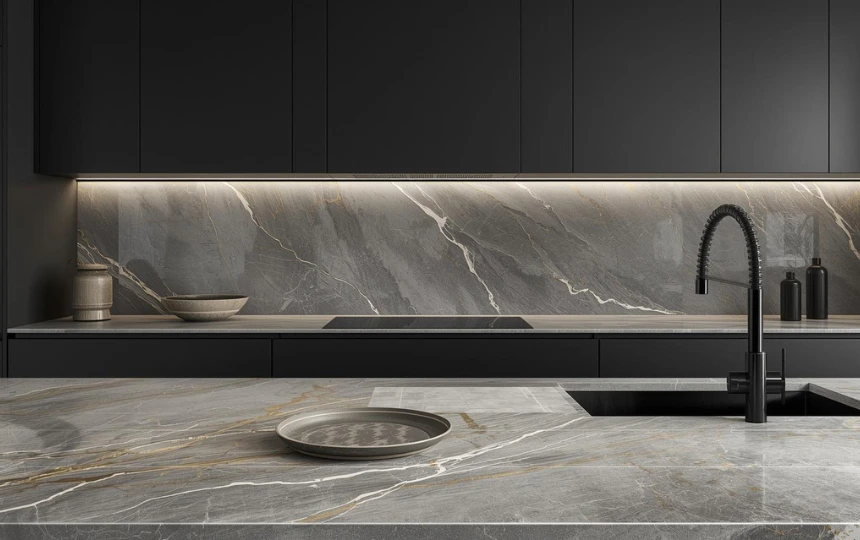
Porcelain slab countertops have become one of the most exciting developments in kitchen design over the past few years. Brands like Neolith, Dekton, and Atlas Concorde produce large-format sintered stone slabs (up to 126 by 63 inches) with digitally printed stone patterns that have become genuinely convincing.
The material is non-porous, heat-resistant to extremely high temperatures, scratch-resistant, UV-stable, and requires zero maintenance. No sealing, no special treatment, nothing. That combination of performance properties exceeds any natural stone on the market.
The biggest design opportunity with porcelain slab is continuity. Running the same slab from the countertop straight up the wall as a full-height backsplash creates an unbroken material plane with no grout lines and no joints. In a kitchen with dramatic veining, the effect is extraordinary. The veining flows from horizontal to vertical as one continuous pattern.
Cost runs from $60 to $150 per square foot installed. The installation requires specialist fabricators with experience handling large, thin slabs. Do not let a generalist tile installer quote you on this material.
Butcher Block: Warmth That Earns Its Place
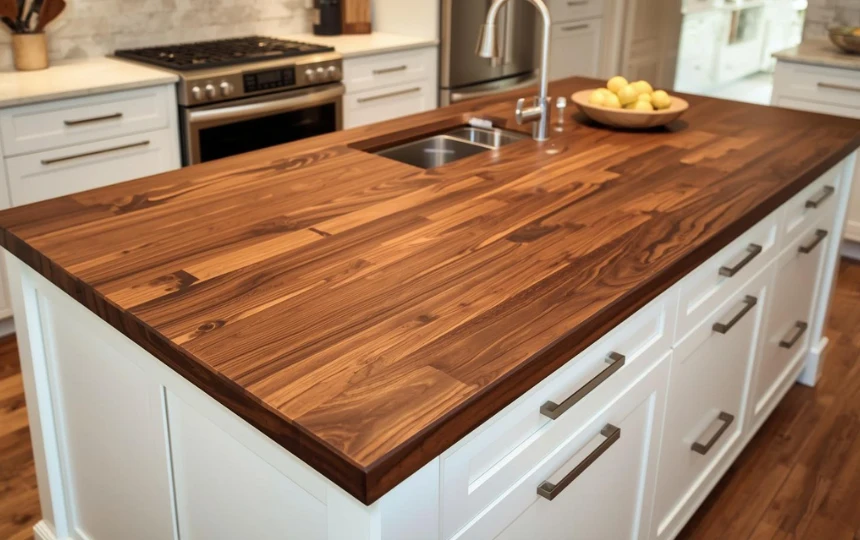
Butcher block countertops are the warmest surface option in any kitchen. That warmth is not just visual. The wood is softer underfoot and quieter to work on than stone. Knives stay sharper longer because you are not cutting against a surface harder than the blade.
The most compelling use of butcher block in a modern kitchen is as a contrast material on the island. Stone on the perimeter countertops, butcher block on the island. The combination introduces organic warmth and material variety that a single-surface kitchen cannot achieve.
Walnut end-grain is the premium choice. The tight circular grain pattern is more water-resistant than face-grain and develops a rich, dark patina over time. White oak and maple are more affordable and both look excellent. Regular oiling with food-safe mineral oil is the only maintenance required.
Cost starts at around $30 per square foot for face-grain maple and reaches $80 to $100 for walnut end-grain. Installation is straightforward. Most butcher block countertops can be self-installed by a competent DIYer.
Concrete: Artisanal and Completely Unique
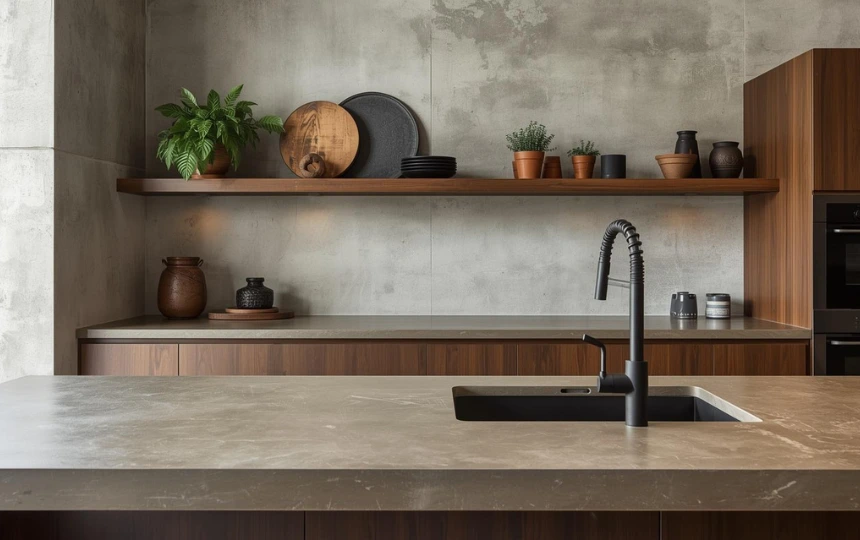
Concrete countertops occupy a category of their own. Every poured concrete surface is unique. The slight color variations, the occasional small imperfection, the subtle texture are not flaws. They are the material’s character, and they are genuinely impossible to replicate with manufactured products.
Concrete can be tinted in a wide range of colors. Warm charcoal, pale bone, dusty terracotta, and matte white are all achievable. It can also be cast to any shape, including integrated sinks, which look extraordinary when executed well.
The maintenance requirements are honest but manageable. Sealed with a quality penetrating sealer and a wax topcoat, concrete resists staining and handles heat reasonably well. It can develop hairline cracks over time due to thermal expansion and contraction. Most owners view these as part of the material’s honest, handmade quality. For others, they are a source of anxiety.
Cost varies widely because the work is labor-intensive. Expect $70 to $150 per square foot for a skilled concrete countertop specialist. The quality of the result depends almost entirely on the skill of the fabricator. This is not a material to source from the lowest bidder.
Dekton: The Outdoor-Ready Workhorse
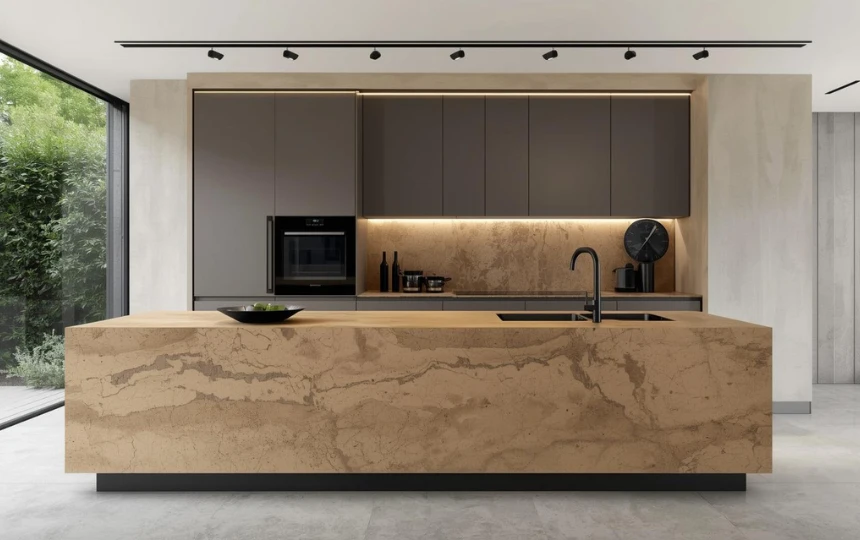
Dekton is a sintered surface made from a blend of raw materials used to produce glass, porcelain, and quartz. The manufacturing process subjects those materials to extreme heat and pressure, producing a surface with properties that exceed almost every other countertop material on the market.
It is virtually scratch-proof. You can place a hot pan directly on it without any protection. It is completely UV-stable, meaning it will not fade or discolor in direct sunlight. It is non-porous and requires no sealing. It is the most technically impressive countertop material currently available for residential use.
It also has one significant practical limitation: it can chip or crack under heavy impact at thin profiles. Very thin Dekton (4mm) is more vulnerable than thicker versions (12mm and above). Specify 12mm or 20mm for kitchen countertop applications.
Dekton is particularly worth considering for kitchens that extend outdoors, homes in sunny climates, or households that want absolute performance without compromise. Cost runs $80 to $180 per square foot installed. Installation requires specialist fabricators trained in the material.
Get a realistic cost estimate for countertops, cabinets, and the full project based on your kitchen size and location.
Specialty & Mixed Countertop Ideas
Ideas 8–10Granite: The Underrated Classic
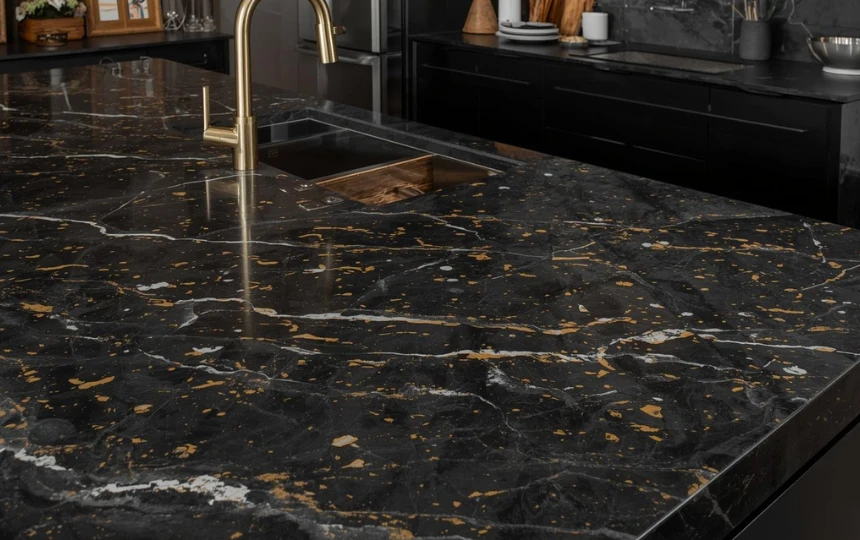
Granite had its design moment in the 1990s and early 2000s and has spent much of the time since being unfairly dismissed. The material itself is excellent. What became tired was the specific granite choices of that era: busy browns, busy beiges, heavily flecked patterns in dated color combinations.
Modern granite selection looks completely different. Dramatic black granites with gold and white mineral movement. Soft grey varieties with subtle speckle. White granites with bold veining that rival marble visually at a fraction of the price. The material range has expanded enormously.
The leathered finish has revived granite’s appeal significantly. Where polished granite can look shiny and dated, a leathered finish produces a matte, slightly textured surface that looks and feels more contemporary. It also hides fingerprints and water spots better than polished.
Granite is harder than marble, more stain-resistant, and generally more durable in daily kitchen use. It requires annual sealing. Cost ranges from $50 to $150 per square foot installed depending on the variety.
Stainless Steel: The Professional Kitchen Choice
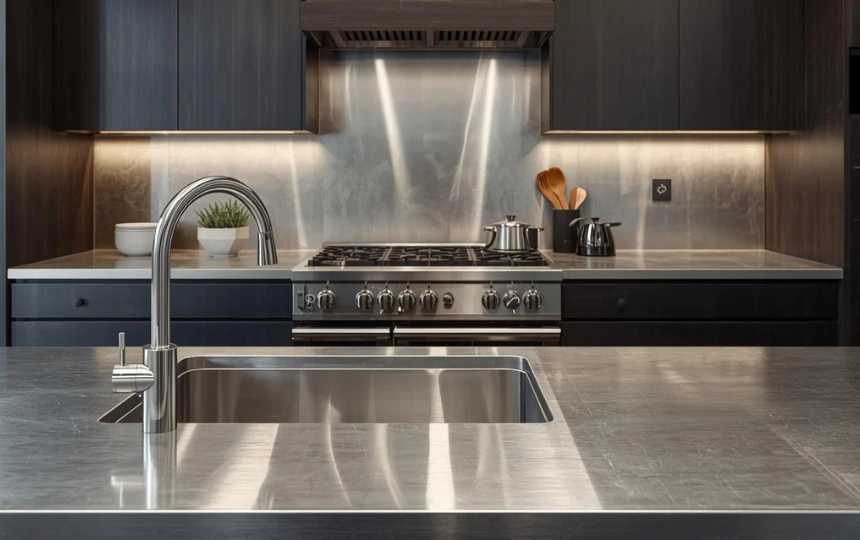
Stainless steel countertops are not for everyone. They are for serious cooks who want a kitchen that functions like a professional environment.
The material is completely non-porous, heat-proof, hygienic, and integrates seamlessly with a built-in sink for a fully continuous work surface. That seamless quality is one of the most functional countertop features available. No joint between countertop and sink means no place for bacteria to accumulate and no caulk to discolor.
A brushed rather than polished finish is essential for residential use. Brushed stainless develops a pleasant worn quality over time and hides the surface scratches that are inevitable with daily use. Polished stainless shows every mark immediately.
Used throughout the kitchen, stainless reads as utilitarian unless the rest of the design compensates with warmth elsewhere (dark wood cabinetry, warm lighting, natural textures). Used on the perimeter countertops alongside a butcher block island, it creates a striking professional-domestic contrast that works very well in contemporary kitchens. Cost runs $80 to $150 per square foot for custom fabrication.
Mixed Materials: Two Countertops, One Kitchen
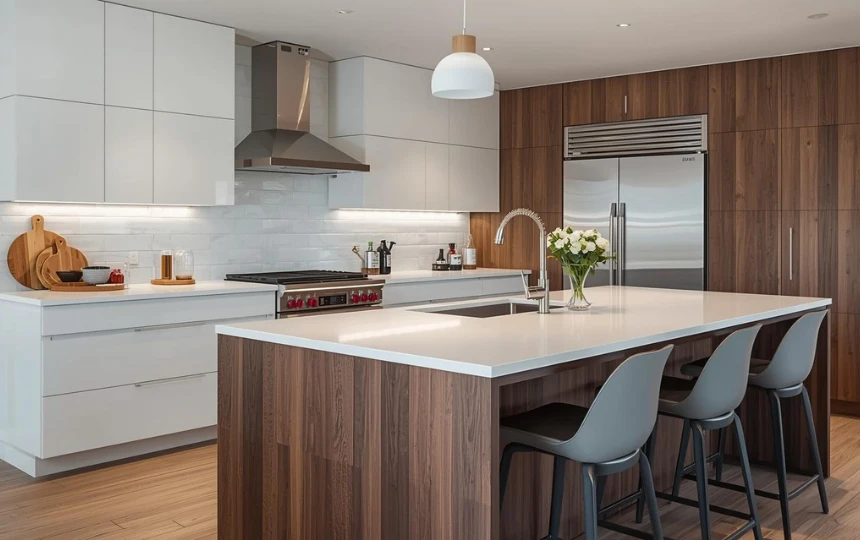
Nobody says every countertop in a kitchen has to be the same material. In fact, mixing materials intentionally is one of the better design decisions you can make.
The most common and effective combination is stone on the perimeter countertops and butcher block on the island. The stone handles the zones near the sink and stove where water resistance matters most. The butcher block on the island adds warmth, knife-friendly prep space, and visual variety that elevates the whole kitchen.
Other combinations work well too. Quartz on the perimeter and concrete on the island. Marble on the island as a statement piece with durable quartz on the working countertops. Stainless steel near the range and quartzite on the rest of the perimeter.
The principle that makes this work: use the most durable material in the highest-use zones. Use the most beautiful or interesting material where it gets the most visual attention. The island is both the most visually prominent surface and often sees somewhat less intense daily use than the perimeter countertops. That makes it the natural place for the more expressive material choice.
Countertop Material Comparison
Buyer’s Guide| Material | Durability | Maintenance | Installed Cost/sqft | Best For |
|---|---|---|---|---|
| Quartz | ★★★★★ | Very Low | $55–$150 | Busy families, everyday use |
| Honed Marble | ★★★☆☆ | High | $75–$250 | Aesthetic-first, low-traffic kitchens |
| Quartzite | ★★★★☆ | Medium | $75–$200 | Natural stone look with more durability |
| Porcelain Slab | ★★★★★ | Very Low | $60–$150 | Continuity with backsplash, heat-heavy use |
| Butcher Block | ★★★☆☆ | Medium | $30–$100 | Islands, warm contrast material |
| Concrete | ★★★☆☆ | Medium | $70–$150 | Industrial, artisanal kitchens |
| Dekton | ★★★★★ | Very Low | $80–$180 | Outdoor kitchens, maximum performance |
| Granite | ★★★★★ | Low | $50–$150 | Durable natural stone at reasonable cost |
| Stainless Steel | ★★★★★ | Low | $80–$150 | Professional kitchens, hygienic priority |
The Question That Changes Everything
Before choosing any countertop material, ask yourself this: if a lemon is squeezed directly on this surface and the juice sits for ten minutes before being wiped, how do I feel about that? If the honest answer is anxious, do not choose marble or any other calcium-carbonate stone. Choose quartzite, quartz, or porcelain instead. The most beautiful countertop you can think of becomes a source of daily stress if the material’s requirements do not match your actual cooking habits. Match the material to the kitchen you have, not the kitchen you imagine.
Want to See How Countertops Fit Your Kitchen Style?
Our interior design style quiz matches you with the materials and aesthetics that suit your home. Free and takes two minutes.
Take the Style Quiz →Choose the Countertop for the Kitchen You Actually Have
The best countertop is the one that suits your actual cooking habits, your household’s reality, and your aesthetic sensibility in that order.
If you cook daily with high heat and heavy use, Dekton or porcelain slab will serve you better than marble. If you want natural stone’s irreplaceable character and are willing to manage its requirements, quartzite gives you that without marble’s vulnerability. If budget is the primary constraint, quality quartz delivers an excellent result at a price point that works for most renovations.
Whatever you choose, buy the best quality you can within the material category. The difference between entry-level and mid-tier quartz is visible. The difference between an experienced stone fabricator and an inexperienced one is even more so.
Frequently Asked Questions About Kitchen Countertops
Quartz remains the best all-round choice for most kitchens. It is non-porous, requires no maintenance, is heat and scratch-resistant, and is available in a wide range of colors and patterns including convincing natural stone effects. For homeowners who want genuine natural stone, quartzite offers better durability than marble with a similar aesthetic. For the best possible performance regardless of aesthetics, Dekton and porcelain slab exceed every other material on technical specifications.
Marble is a good kitchen countertop for the right household. It etches with acidic liquids and requires annual sealing. For homeowners who cook frequently with acidic ingredients, have young children, or prefer a worry-free surface, marble is a poor practical choice. For homeowners who cook moderately, appreciate a surface that develops a patina over time, and are genuinely at peace with the maintenance requirements, honed marble is a deeply beautiful and satisfying material. Be honest about which category you fall into before committing.
Quartz is an engineered material made from crushed quartz stone bound with resin. It is manufactured in controlled conditions, non-porous, and requires no maintenance. Quartzite is a naturally occurring metamorphic rock formed from sandstone under heat and pressure. It is a genuine natural stone with natural variation, requires sealing, but is significantly harder and more acid-resistant than marble. They are often confused in showrooms. Ask the supplier directly and request the material specification sheet if unsure.
Kitchen countertop costs vary widely by material. Butcher block starts at around $30 per square foot installed. Standard quartz runs $55 to $150 installed. Granite typically costs $50 to $150. Marble and quartzite range from $75 to $250 or more depending on the stone. Dekton and porcelain slab cost $80 to $180 installed. Concrete and stainless steel sit in the $70 to $150 range. For a standard kitchen with 30 square feet of countertop area, the total cost ranges from roughly $1,500 to $7,500 depending on material. Use our renovation cost calculator for a personalized estimate.
The standard countertop thickness for natural stone and quartz is 3cm (approximately 1.25 inches). This is the most structurally sound and visually proportional thickness for most kitchen countertops. Thicker slabs (4cm to 5cm) create a more dramatic, furniture-like profile and look particularly impressive on islands. Thinner slabs (2cm) can be used with a mitered edge built up at the front to create the appearance of a thicker slab at a lower cost and weight. For Dekton and porcelain slab, specify 12mm or 20mm for countertop applications rather than thinner tile formats.
It depends on the material. Quartz, Dekton, porcelain slab, and stainless steel are all non-porous and require no sealing. Natural stone materials including marble, quartzite, granite, limestone, and travertine are porous to varying degrees and should be sealed annually with a penetrating stone sealer. Concrete countertops require both a penetrating sealer and a topcoat. Butcher block countertops require regular oiling with food-safe mineral oil rather than sealing. Always check the manufacturer’s specific recommendations for the product you choose.