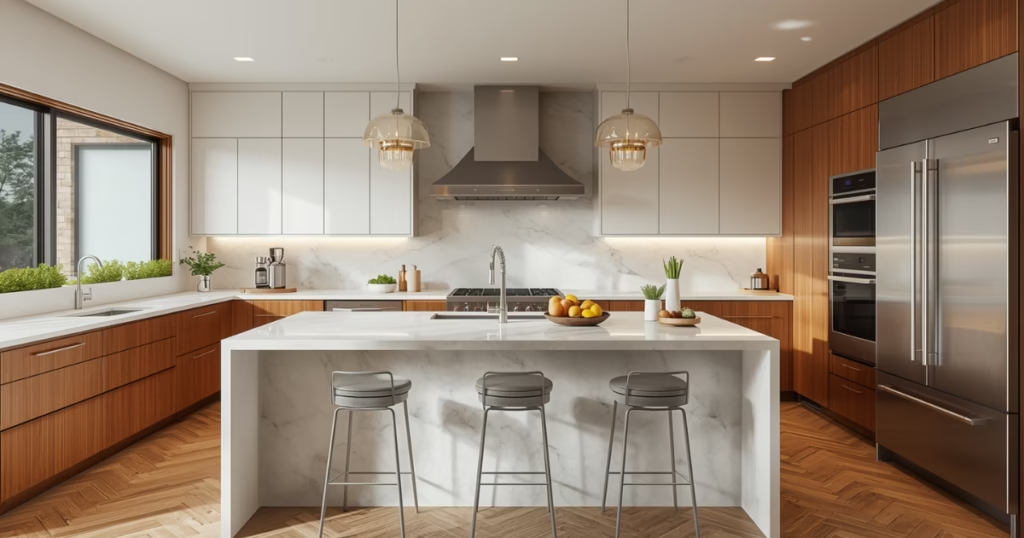
13 Modern Kitchen Cabinet Ideas Worth Stealing in 2026
Cabinets take up most of your kitchen budget and most of your kitchen’s visual space. These 13 ideas will help you spend that budget well.
Cabinets are the single biggest decision in any kitchen remodel. They eat up 30 to 40 percent of the total budget. They cover most of the wall space. And they set the visual tone for everything else that follows.
Get them right and the whole kitchen clicks into place. Get them wrong and no backsplash or lighting upgrade will fully save it.
We put together 13 cabinet ideas that are genuinely worth considering in 2026. Not the same recycled images you see on every other site. Just ideas that work in real homes, with real budgets, and real people living in them.
Cabinet Style & Form
Ideas 1–6Handleless Flat-Front Cabinets
If you want one thing to instantly make a kitchen look modern, this is it.
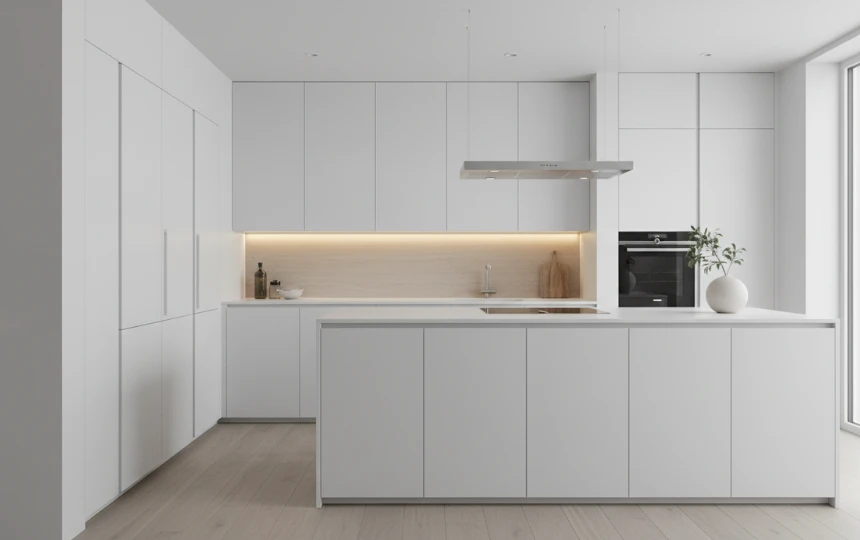
Handleless cabinets remove every visual interruption from the cabinet face. No knobs, no pulls, no hardware at all. The door itself is the whole story. Push-to-open mechanisms or integrated J-pull channels keep it functional without adding anything visual.
The result is clean in a way that cabinets with hardware simply cannot be. It works especially well when you extend the cabinetry all the way to the ceiling. That one move alone makes a standard kitchen feel like it was designed by an architect.
Matte finishes work better than gloss here. Gloss shows every fingerprint. Matte keeps things looking composed even after a busy cooking session. White, warm grey, and pale greige are the easiest colors to live with long term.
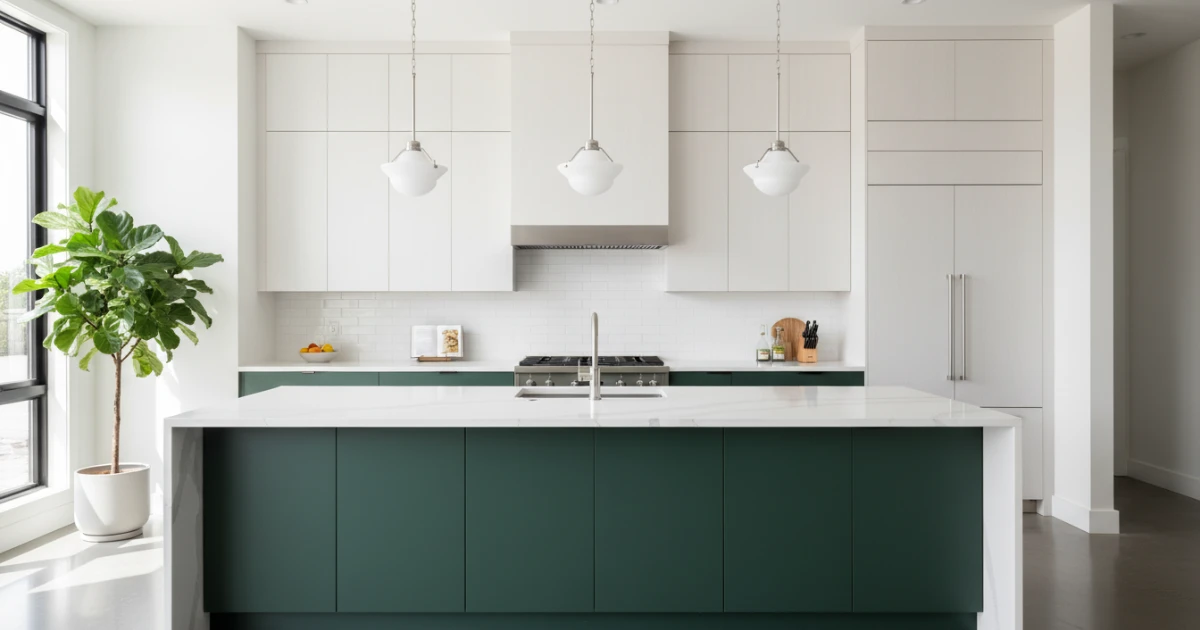
Two-Tone Cabinetry: Dark Lowers, Light Uppers
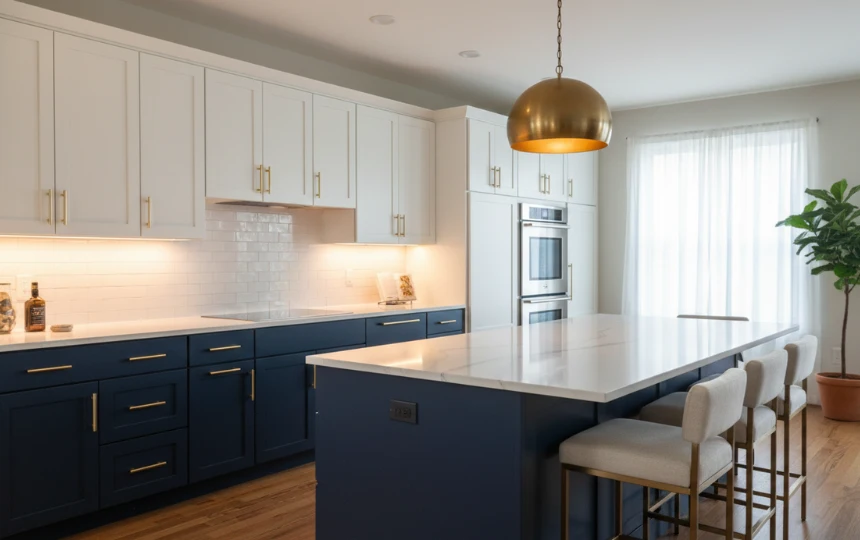
Two-tone cabinets have been popular for a few years now. But unlike most trends, this one has real design logic behind it.
Darker lowers and lighter uppers ground the kitchen visually. The heavier color sits at the bottom where it belongs, and the lighter color keeps the top half of the room feeling open. It also mimics how furniture works, which is why kitchens with two-tone cabinets often feel more like a designed room and less like a utilitarian space.
Navy and white is the most classic pairing. Sage green and cream works beautifully too. Charcoal and off-white is a safer, more neutral version that suits almost any home.
One thing to keep consistent: use the same door profile for both colors. Changing the profile as well as the color makes the kitchen look confused rather than considered.
Floor-to-Ceiling Storage Wall
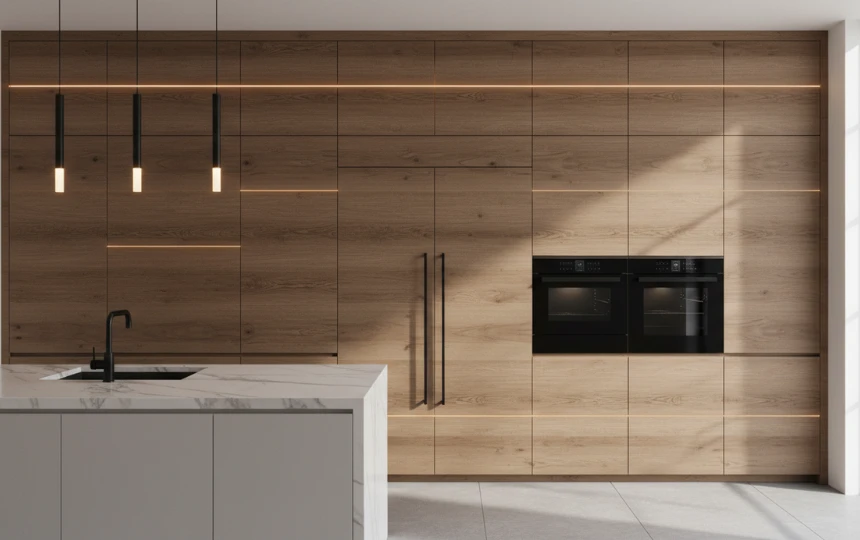
Most kitchens have a gap between the top of the upper cabinets and the ceiling. It collects dust. It breaks the visual rhythm of the room. And it makes the ceiling feel lower than it is.
Taking the cabinetry all the way to the ceiling fixes all three problems at once.
When you do this across an entire wall, integrating the refrigerator and oven behind matching cabinet panels, the result stops looking like a kitchen and starts looking like architecture. The whole wall becomes one unified element. It photographs beautifully and it reads as expensive regardless of what the cabinets actually cost.
This works especially well in open-plan homes where the kitchen wall is visible from the living area. A floor-to-ceiling cabinet wall creates a polished backdrop for the whole space.
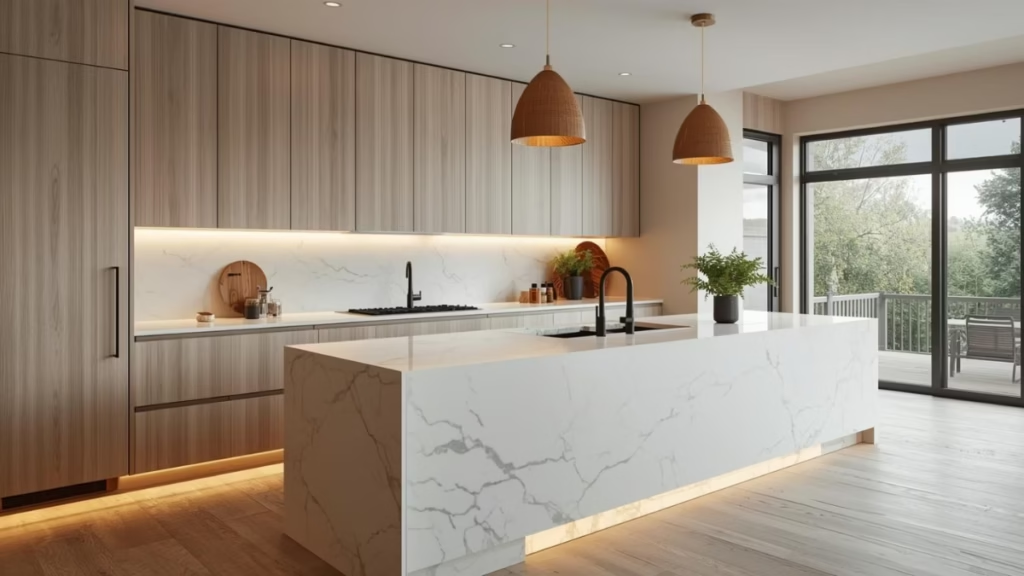
Natural Wood Veneer Cabinets
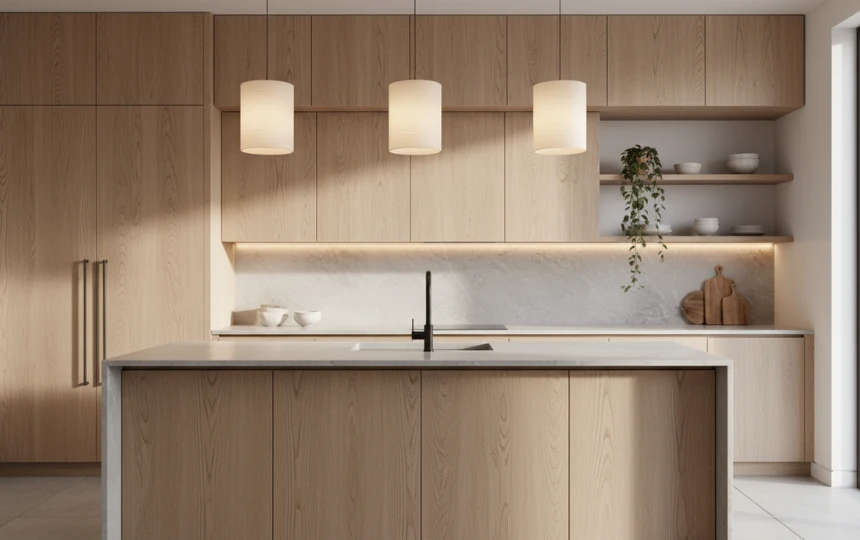
There is something paint simply cannot replicate. The way natural wood grain catches light. The subtle variation from door to door. The feeling that the material is genuinely alive.
White oak veneer is the most popular choice right now and it deserves the attention. It has a calm, warm tone that works in almost any kitchen. Walnut is richer and darker, better suited to kitchens where a touch of drama is welcome. Ash and cerused oak sit between the two.
The key to making wood veneer cabinets look right is restraint everywhere else. Honed stone countertops rather than polished. No hardware, or very minimal hardware. Simple flooring. Let the wood do the work.
This is the cabinet style that defines the Japandi aesthetic. And it is the one that tends to age best. Ten years from now, a well-done oak veneer kitchen will still look considered and timeless.
Deep Green Cabinets
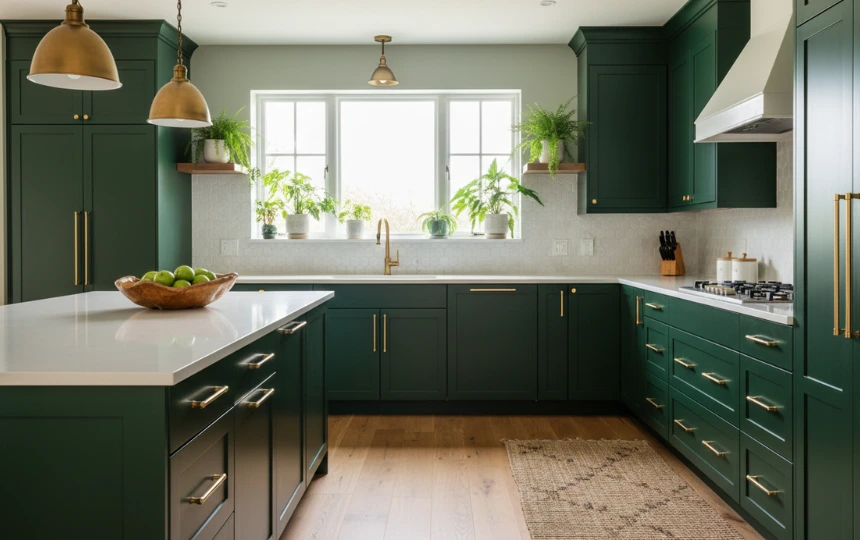
Green has been having its moment in kitchen design for a few years now. And unlike most trends, it shows no sign of stopping.
The reason is simple. Green is connected to nature. It feels grounded and calm. And unlike most bold colors, it plays well with almost every countertop material and hardware finish.
Hunter green and forest green are the most popular shades. They work with white quartz, warm quartzite, and honed marble equally well. Sage green is a softer option that suits smaller kitchens or rooms with limited natural light. Olive green sits somewhere between the two and has a slightly more earthy, Mediterranean quality.
Unlacquered brass hardware is the natural partner for green cabinets. The warm metal tones bring out the richness in the paint and the combination feels genuinely timeless.
Shaker Style, Done the Modern Way
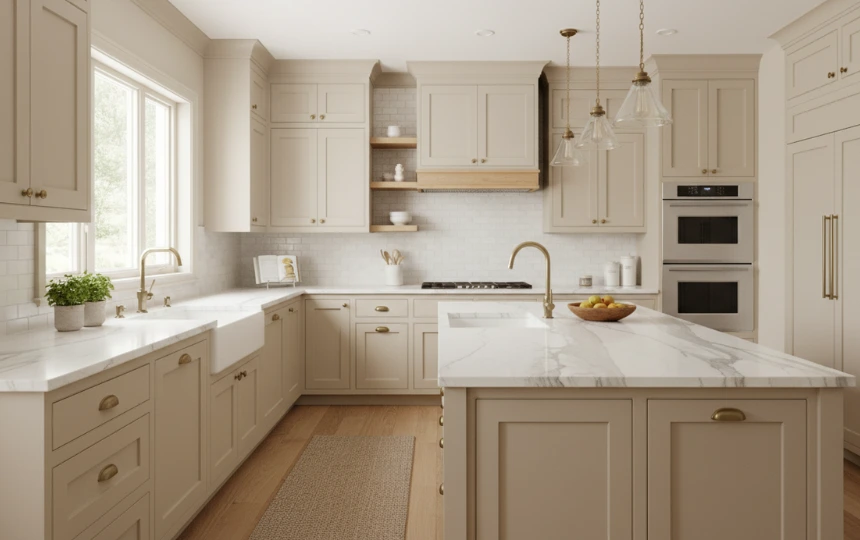
Shaker cabinets get dismissed as boring. They are not. They are just often executed badly.
The original Shaker style was about simplicity and honesty of materials. A flat center panel in a simple frame. No ornament. Nothing unnecessary. That is actually a very modern idea.
The mistake people make is choosing a thick, chunky shaker profile in a contractor white. That version does look dated. The modern approach is a thinner frame, a flatter center panel, and a warm color rather than a stark white. Paint it linen, parchment, or warm grey. Add cup pulls in aged brass instead of bin pulls in polished chrome.
Done this way, shaker cabinets bridge the gap between traditional and contemporary. They suit almost any home and they will still look good in twenty years.
Our interior design style quiz takes two minutes and gives you a clear direction before you start spending.
| Cabinet Material | Durability | Cost Range | Best For | Avoid If |
|---|---|---|---|---|
| Solid Wood | ★★★★★ | $$$-$$$$ | Longevity, refinishing | Humid kitchens |
| Wood Veneer MDF | ★★★★☆ | $$-$$$ | Natural look, stability | Water damage risk areas |
| Painted MDF | ★★★★☆ | $$ | Flat-front, color options | Budget door profiles |
| Thermofoil | ★★★☆☆ | $ | Tight budgets | High-heat zones |
| Laminate | ★★★★☆ | $-$$ | Moisture resistance | Edge chip risk areas |
| Lacquer | ★★★★☆ | $$$ | High-gloss or matte finish | Households with young kids |
Color, Display & Function
Ideas 7–13Glass-Front Display Cabinets
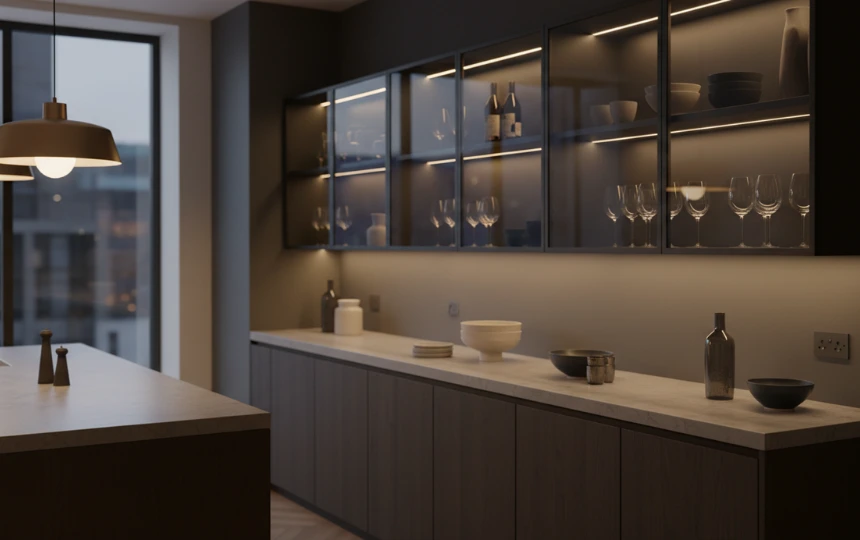
Glass-front cabinets do something solid doors cannot. They add depth to the kitchen without adding square footage.
The trick is lighting them from the inside. A small LED strip at the top of the cabinet interior turns your glassware or ceramics into a display. In the evening, when the kitchen lights are dimmed, lit glass-front cabinets glow like small illuminated boxes. It is genuinely beautiful and adds a warmth that no pendant light or countertop lamp can replicate.
You do not need to do this on every upper cabinet. In fact, you should not. Two or three glass-front doors on one section of wall, flanked by solid doors on either side, is the right approach. It gives you the visual relief without requiring you to keep everything behind glass looking perfect all the time.
Paint the cabinet interior a contrasting color. Navy inside a white cabinet is dramatic. Black inside a sage green cabinet looks incredible. The contrast amplifies the jewel-box effect enormously.
Open Floating Shelves (Used Carefully)
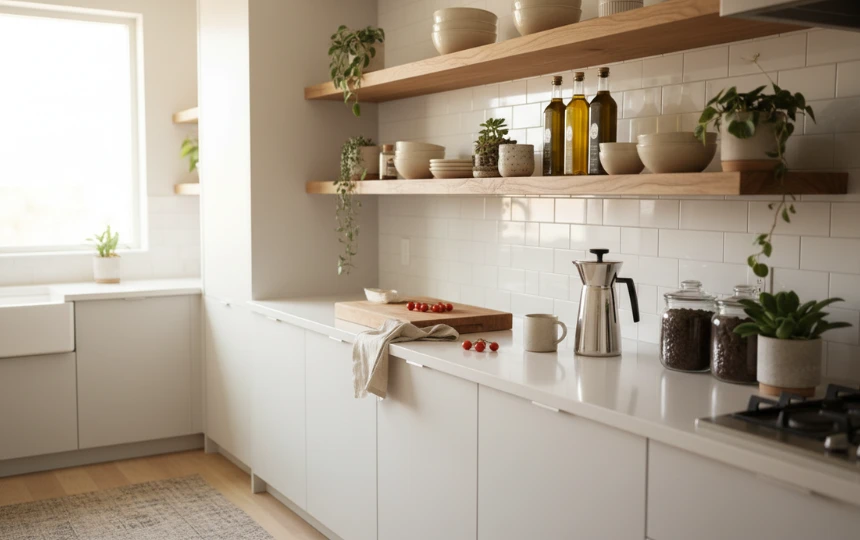
Open shelves are polarizing. People either love them or refuse to consider them.
The truth sits somewhere in the middle. Full open shelving on every wall is impractical for most households. But replacing one or two upper cabinet runs with thick floating shelves adds a warmth and openness that closed cabinets simply cannot provide.
The word “thick” matters here. Shelves cut from 2.5-inch solid wood or made to look that substantial are the difference between something that looks architecturally intentional and something that looks like a flat-pack afterthought.
Style them with everyday items rather than purely decorative objects. Your nicest olive oil bottle. A small plant. A stack of ceramic bowls you actually use. That lived-in quality is what makes open shelves look considered rather than curated to death.
Warm White and Cream Cabinets
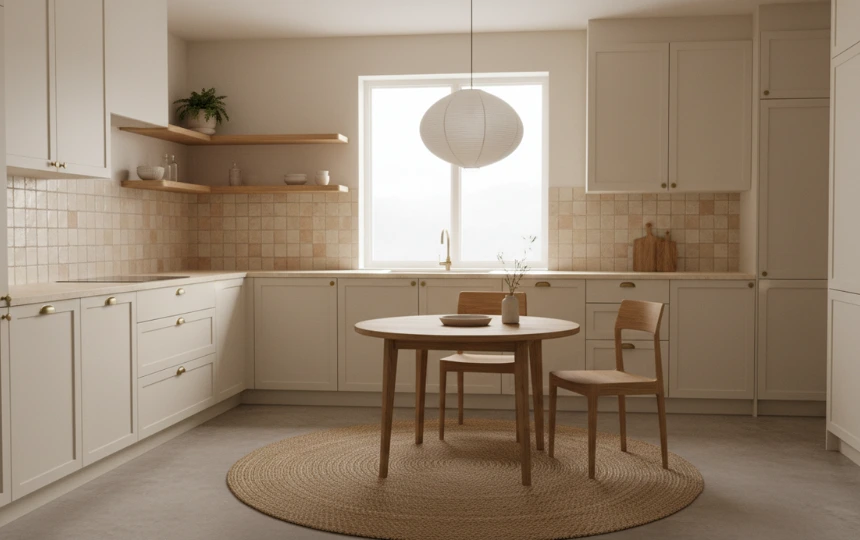
White kitchens are not going anywhere. But the white that works in 2026 is not the same white that dominated a decade ago.
Cool, blue-toned whites have given way to warmer alternatives. Linen, parchment, antique white, and warm ivory all have yellow or pink undertones that look completely different under natural light. They glow rather than glare. They feel genuinely inviting rather than clinical.
This shift extends beyond just the cabinet color. Warm white cabinets pair best with creamy quartzite rather than stark Carrara marble. With aged brass hardware rather than brushed nickel. With handmade clay backsplash tiles rather than high-gloss subway tiles.
The whole palette moves toward warmth. And the result is a kitchen that photographs beautifully and feels good to spend time in, which is ultimately the point.
Navy Blue Cabinets
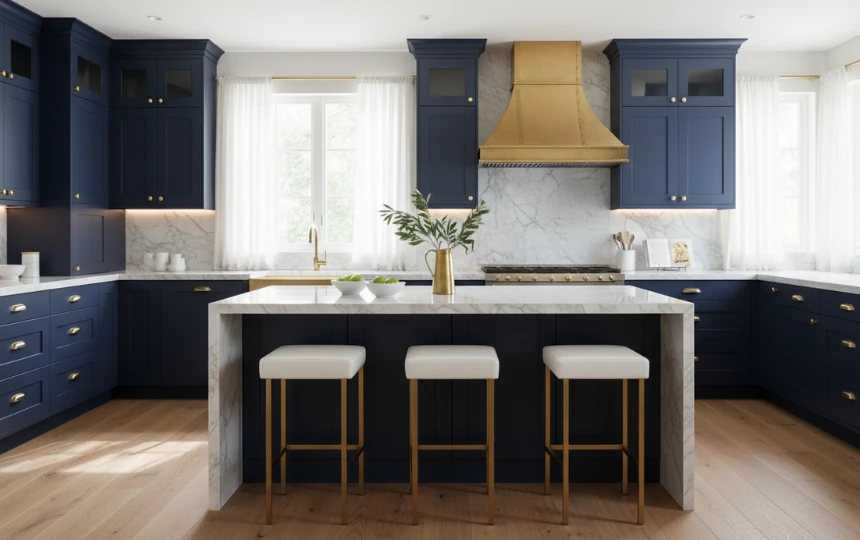
Navy blue has earned its place as a genuinely timeless cabinet color. It is not a trend. It is closer to a classic that periodically gets rediscovered.
The reason it works so well is contrast. Navy against white countertops is one of the sharpest, most satisfying color combinations in kitchen design. It creates definition without aggression. And it works in both traditional and contemporary kitchen profiles, which is rare for a bold color.
Navy works best on lower cabinets or as a full-kitchen color in rooms with good natural light. In darker rooms, it can read as oppressive rather than sophisticated. If your kitchen is north-facing or short on windows, sage green or warm off-white will serve you better.
For hardware, brass is the obvious choice and also the right one. Polished nickel works too if you want something cooler and more restrained.
The Concealed Pantry Door
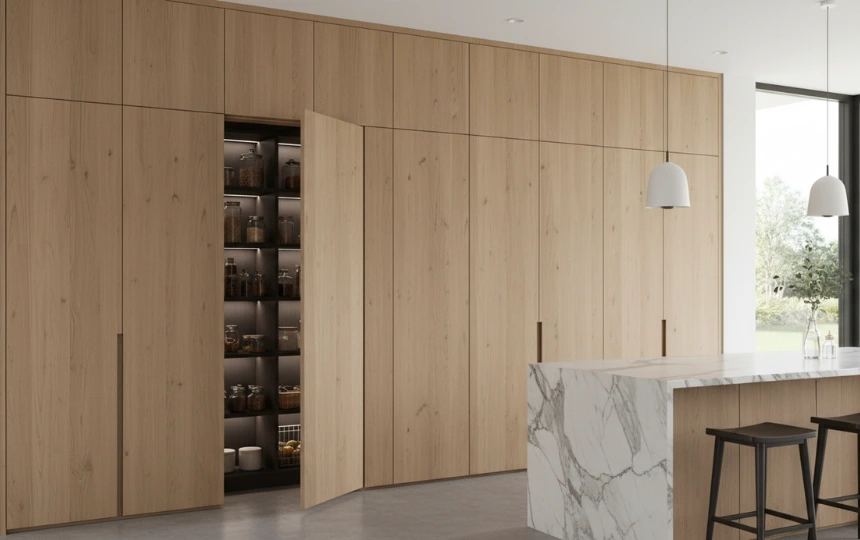
A pantry door that disappears into the cabinet wall is one of those details that guests never quite understand until you show them.
The idea is simple. Clad the pantry door with the same panels as the surrounding cabinets. Use a push-to-open mechanism so there is no handle to break the visual continuity. The door becomes invisible. The wall looks like one unbroken run of cabinetry. And behind it, your pantry can be as practical and unglamorous as you need.
This works particularly well in open-plan kitchens where you want the space to look clean and uncluttered from the living area. The kitchen can absorb a full pantry worth of storage while showing nothing but a serene, continuous wall.
The joinery does need to be precise. This is not a DIY project. But the result is worth the investment, especially if you are already spending on quality cabinetry elsewhere.
All-Black Cabinetry
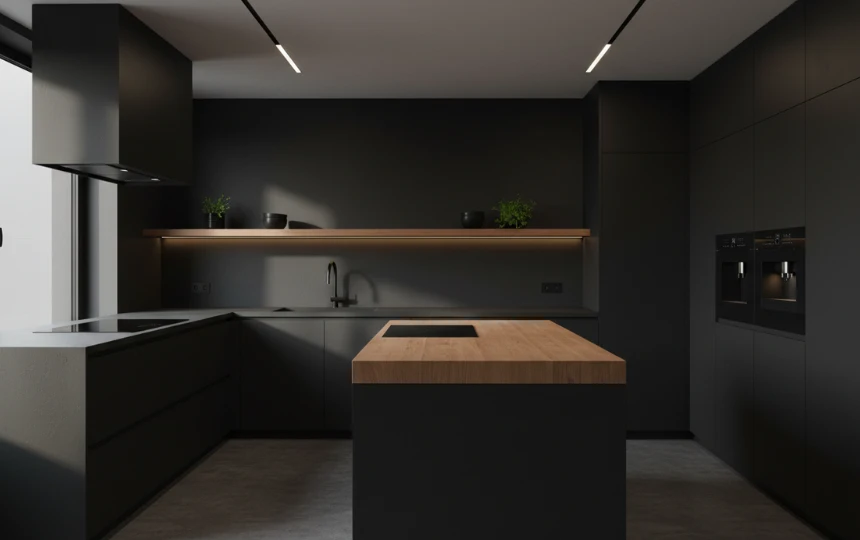
An all-black kitchen is not for the hesitant. But for the right person, in the right home, it is genuinely extraordinary.
The challenge with all-black cabinetry is preventing the kitchen from feeling flat or oppressive. The solution is texture. Matte black cabinet doors alongside honed black granite, rough blackened steel, and aged brass fixtures produce a surface dialogue that gives the monochrome palette real depth. Every material needs to be slightly different from the next.
Natural wood is the other essential ingredient. A butcher block island section, a floating oak shelf, or a wood dining table adjacent to the kitchen introduces warmth that keeps the space feeling alive rather than austere.
Natural light matters too. A south-facing kitchen with large windows can carry all-black beautifully. A dark, north-facing kitchen with small windows probably cannot.
Drawer-Heavy Base Cabinets
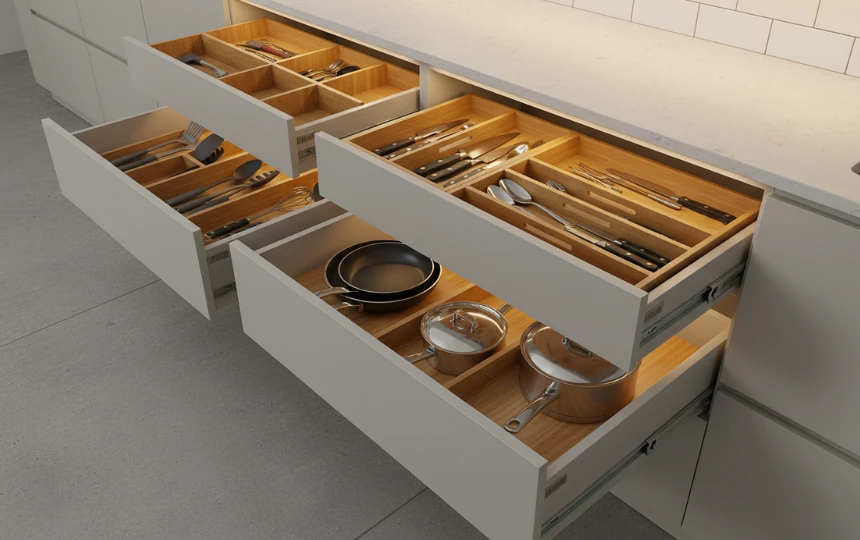
This is the least glamorous idea on this list. It is also the one that will change how your kitchen works most dramatically.
Standard base cabinets come with a door and one or two shelves inside. To get anything at the back, you have to crouch down, reach in, and rummage. It is inefficient and frustrating and it is the default in most kitchens.
Replacing those doors and shelves with deep drawers on full-extension, soft-close runners changes everything. Pull the drawer out and everything is visible and accessible at once. Pots, pans, dry goods, utensils. No more crouching. No more rummaging.
It costs more than standard base cabinets. A good drawer system from Blum, Grass, or Hafele is not cheap. But the daily improvement to how your kitchen functions is significant enough that most people who have done it say it was the best money they spent on the whole project.
If budget is a constraint, prioritize drawers in the zones you use most. The cabinet next to the stove and the cabinet under the main prep area will get you the biggest return.
One Thing to Decide Before Anything Else
Before you choose a color or a door profile, decide how you want your kitchen to feel. Calm and quiet? Warm and characterful? Bold and dramatic? Everything else follows from that answer. A matte white handleless cabinet and a warm oak veneer cabinet can both be “modern.” But they create completely different rooms. Get clear on the feeling first, then choose the materials that deliver it.
Budgeting for New Cabinets?
Our renovation cost calculator gives you a realistic estimate based on your kitchen size, cabinet type, and location. Free to use and takes under a minute.
Calculate Your Budget →Pick One Idea and Commit to It
The kitchens that look best are never the ones that tried to do everything. They are the ones that made one or two clear decisions and executed them properly.
Maybe that is floor-to-ceiling oak veneer cabinets with no hardware. Maybe it is two-tone navy and white with unlacquered brass. Maybe it is just switching to drawer-heavy base units and repainting the existing doors in a warmer color.
Whatever you choose, spend more time getting that one thing right than spreading the budget thin across many small upgrades. The kitchen will thank you for it.
Frequently Asked Questions About Kitchen Cabinets
Handleless flat-front cabinets continue to be the top choice in contemporary kitchens. Natural wood veneer, particularly white oak, is the fastest-growing style as the Japandi aesthetic gains ground. Two-tone cabinetry with dark lowers and light uppers remains popular across both modern and transitional homes. For color, deep greens and warm off-whites are leading, with navy holding strong as a classic option.
Kitchen cabinet costs vary widely depending on the type and quality. Stock cabinets from home improvement stores start at around $60 to $200 per linear foot installed. Semi-custom cabinets run $150 to $650 per linear foot. Fully custom cabinets can reach $500 to $1,500 per linear foot or more. For a mid-size kitchen of around 200 square feet, most homeowners spend between $8,000 and $30,000 on cabinetry alone. Use our renovation cost calculator for a personalized estimate.
Yes. Shaker cabinets are genuinely timeless rather than trendy. The key is how you execute them. A thin rail profile, warm paint colors, and quality hardware keep shaker cabinets looking current. The version that feels dated is the thick-framed, contractor-white shaker with generic chrome bin pulls. Update those three elements and shaker style is as relevant in 2026 as it has ever been.
Warm whites and off-whites are the most universally successful choice. They work in almost any kitchen, suit any hardware finish, and hold resale value well. For something with more character, deep forest green with brass hardware is the standout combination of the moment. Navy blue remains a reliable classic. If you want to be safe but not boring, a warm greige or soft sage green sits between neutral and bold in a way that almost always works.
Custom cabinets are worth the cost in kitchens with unusual layouts, specific storage needs, or where the kitchen is a central design priority in the home. For straightforward rectangular kitchens where stock or semi-custom cabinet sizes fit well, the premium for fully custom is often hard to justify. The better investment is usually spending more on quality hardware and drawer systems within a semi-custom cabinet range, rather than going fully custom on the boxes.
Three changes make the biggest difference without full replacement. First, repaint the doors in a modern color. Warm off-white, sage green, or charcoal all transform dated cabinets immediately. Second, replace the hardware. New bar pulls or cup pulls in aged brass or matte black cost very little and have a disproportionate visual impact. Third, add under-cabinet LED lighting. It modernizes the kitchen atmosphere instantly and improves how the space functions. If budget allows, also consider replacing just the doors while keeping the existing cabinet boxes, which costs significantly less than a full replacement.