9 Modern Kitchen Curtain Ideas That Balance Light and Privacy
Kitchen curtains do two things: they manage light and they add character. Getting both right at the same time is harder than it looks. These 9 ideas show how.
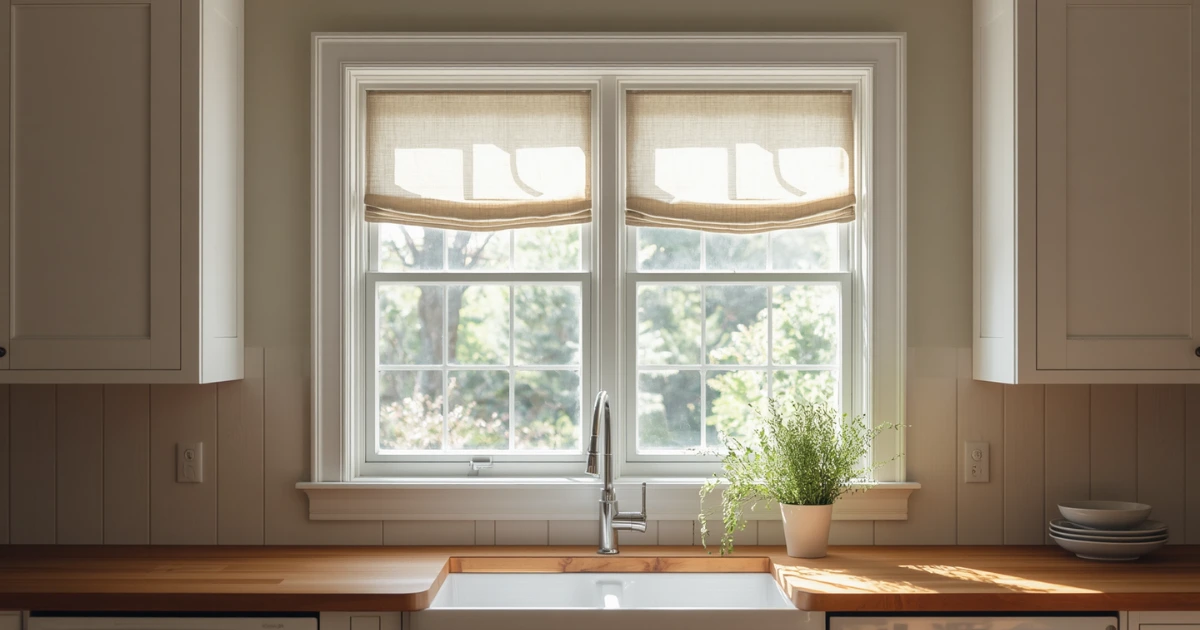
Kitchen curtains are one of the easier things to get wrong. Too heavy and they block the light the kitchen needs. Too fussy and they look out of place in what is fundamentally a practical room. Too short and they look like an afterthought.
The good news is that getting them right is not complicated. It mostly comes down to choosing the right fabric weight, the right length, and the right amount of coverage for what the window actually needs.
We have covered 9 approaches that work in modern kitchens. Including one that is not a curtain at all, which is sometimes the right answer too.
Linen Cafe Curtains
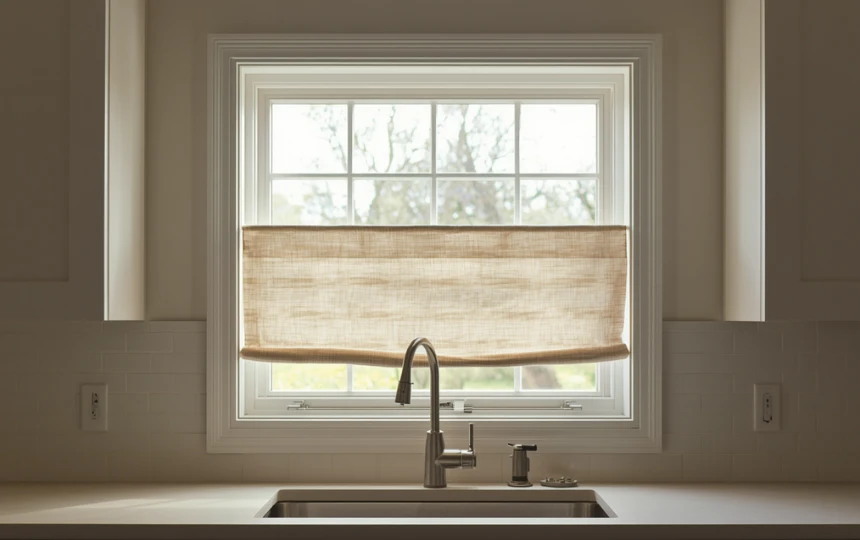
Cafe curtains are the most sensible window treatment for a kitchen sink window. They cover the lower half of the glass for privacy while leaving the upper half completely open for light and view. You get both without compromising either.
Natural linen is the right fabric for this. It is loose enough to let light filter through, has a warmth that cotton and synthetic fabrics lack, and looks better with slight wrinkles rather than worse. You do not need to iron linen cafe curtains. They are supposed to look a little relaxed.
The hardware is part of the look. A slim brass tension rod or a simple wooden dowel on small hooks suits the casual, domestic character of cafe curtains better than a heavy decorative rod. Keep it modest.
In terms of color, natural, undyed linen is the best starting point for most kitchens. It suits white, cream, green, and wood-tone color schemes equally well. A soft sage or warm terracotta linen works if you want to introduce a color note. Avoid very dark colors, which block too much of the limited light that reaches a window above a sink.
Sheer Linen Panels
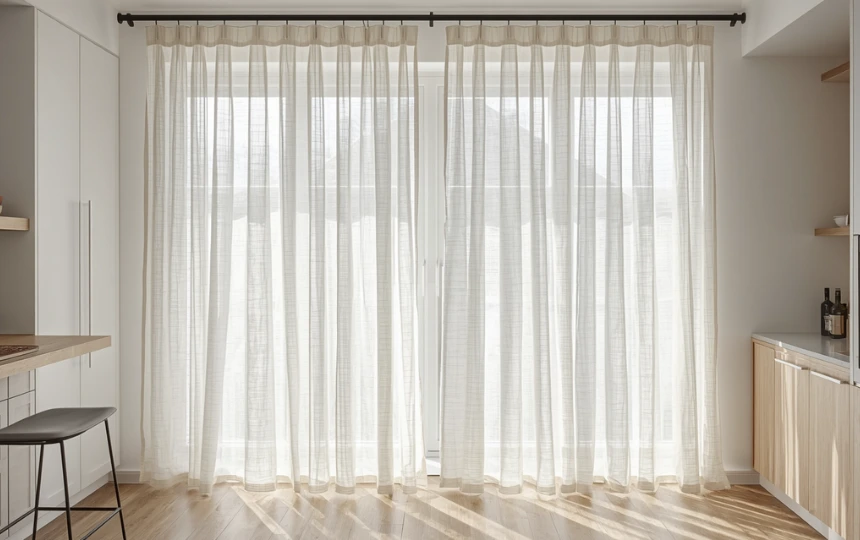
Sheer linen panels do something no other kitchen window treatment does: they soften the light without blocking it. The diffused, warm glow that comes through loosely woven sheer linen in the morning is one of the most beautiful lighting effects you can get in a kitchen without any electrical input.
This works best in kitchens that have a generous window, reasonable natural privacy, and a style that leans toward the relaxed and organic rather than the polished and precise. Sheer panels on floor-length windows in a Japandi or warm-minimalist kitchen look extraordinary. They suit the same kitchen style that white oak cabinetry and honed stone countertops do.
Mount the rod close to the ceiling, not just above the window frame. This makes the ceiling feel higher and the window feel larger. Use panels wide enough that they stack generously to each side when open. Skimpy panels that barely cover the window look inadequate. Each panel should be at least 1.5 times the width of the window for proper fullness.
The practical concern is privacy. Sheer panels diffuse but do not block the view from outside at night when interior lights are on. If your kitchen window faces neighbors at close range, a sheer panel alone may not give you adequate evening privacy. Combine with a simple roller blind behind the sheers for full control.
Roman Shades
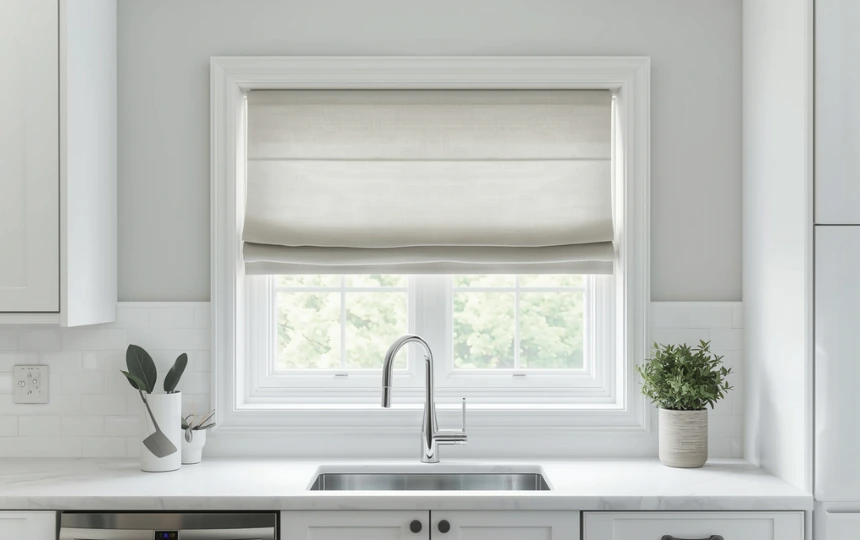
Roman shades are the most architecturally clean window treatment available for a kitchen. When raised, they stack neatly into a compact fold at the top of the window. When lowered, they lie flat as a single panel of fabric. No pooling, no fuss, no visual noise.
Flat Roman shades (no folds when raised, no hobbled or cascading folds when lowered) are the right version for modern kitchens. The structured, geometric form suits contemporary and minimalist aesthetics better than the softer, more traditional folded styles.
Mount them inside the window recess for the cleanest look. Inside mounting means the shade sits within the window frame rather than above it, preserving the architecture of the window surround. It also makes the shade look intentional rather than applied.
Fabric choice matters here. A medium-weight linen or cotton-linen blend in a solid color or subtle texture works best. Avoid very sheer fabric in a Roman shade, which does not hang flat cleanly. And avoid very heavy fabric, which makes the shade feel oppressive when lowered in a kitchen.
Striped Cotton Curtains
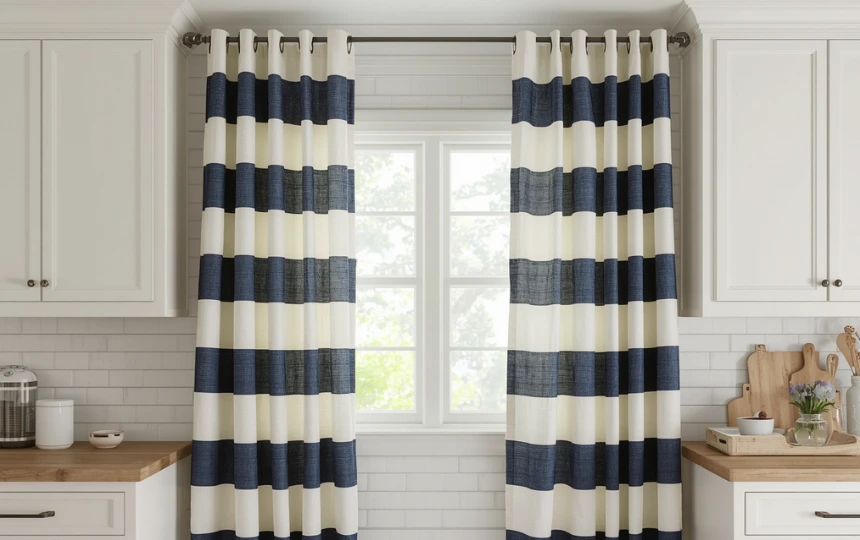
Striped curtains are the most reliable patterned option for a kitchen. The directional pattern is graphic without being demanding. It reads as clean and considered rather than decorative and fussy.
Vertical stripes are the standard choice for curtains because they emphasize height and make ceilings feel taller. In a kitchen where the windows are wide rather than tall, horizontal stripes can work to emphasize the width of the window and the breadth of the space.
The color combinations that work best in modern kitchens right now are navy and white, sage and cream, terracotta and natural, and charcoal and oatmeal. All four have enough contrast to read as deliberate without being loud. All four are washable in cotton, which matters in a kitchen.
Keep the rest of the kitchen relatively calm if you go with a striped curtain. They work best when they are the only patterned element in the room. A patterned backsplash plus striped curtains plus a patterned rug is too much happening at once.
No Curtains at All
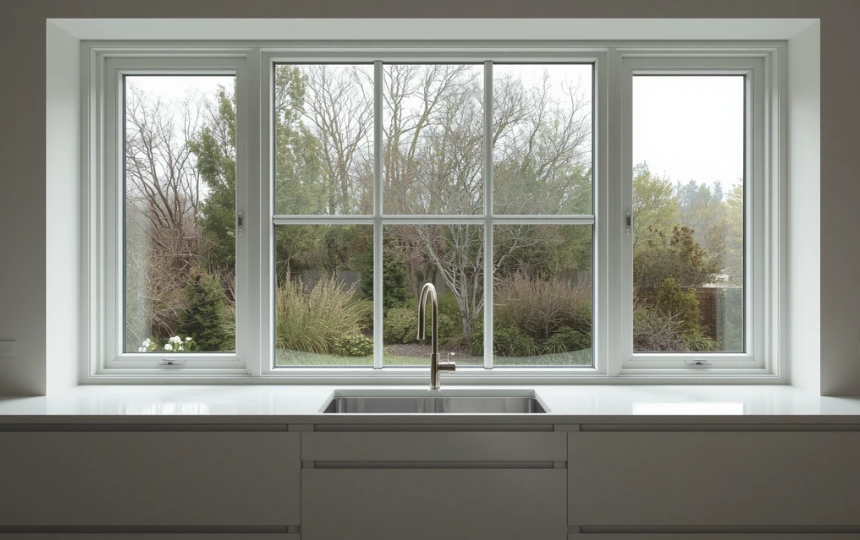
Sometimes the right answer is nothing. A kitchen that has adequate natural privacy from neighboring windows, a pleasant view, and a design philosophy of restraint often looks better without any window treatment at all.
Bare windows maximize natural light. They let the view become part of the room. They make the kitchen feel cleaner and more open. And they are the easiest thing to maintain because there is nothing to wash, replace, or adjust.
This works best in kitchens that face a garden, courtyard, or open aspect with limited direct overlooking. It also suits very contemporary and minimalist kitchens where every added element needs a clear reason to exist. A curtain in a kitchen like that requires justification. No curtain requires none.
If you are on the fence about whether you need window treatments in your kitchen, try living without them for a month first. Many people discover that the additional light and the cleaner aesthetic is preferable to the privacy or solar control the curtain provides. You can always add something later if you find you genuinely need it.
Floor-Length Curtain Panels
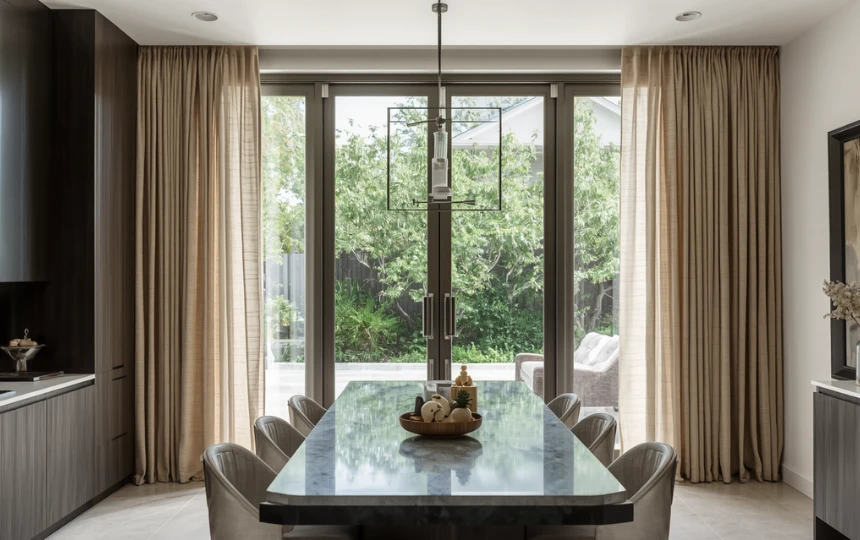
Floor-length curtains in a kitchen are more unusual than in a living room, which is precisely what makes them look so good when they are done right. They signal that the kitchen is a room worth dressing properly, not just a functional space to be managed efficiently.
They work best in open-plan kitchens with large windows, patio doors, or bifold doors where the scale of the opening justifies a substantial treatment. A floor-length curtain on a small kitchen window looks disproportionate. On a large opening in an open-plan space, it looks exactly right.
The key is to mount the rod wide and high. Wide means extending the rod well beyond the window frame on each side so the curtains frame the opening rather than covering it when open. High means mounting the rod as close to the ceiling as possible. Both moves make the window and the ceiling feel larger.
Let the fabric just touch the floor or puddle very slightly. A curtain that stops an inch above the floor looks like a measurement error. One that touches the floor looks intentional. One that puddles two or three inches looks deliberately relaxed and generous.
Patterned Curtains as a Statement
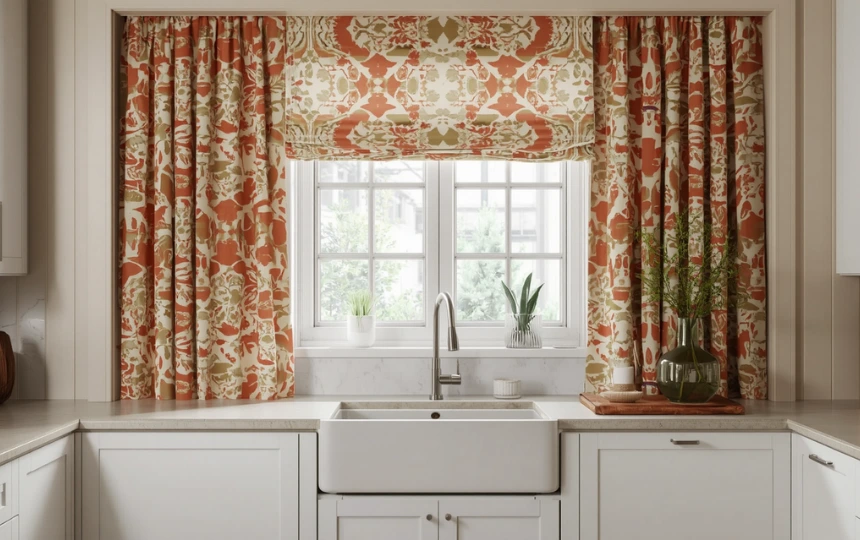
A patterned curtain in a kitchen is a commitment. It is declaring that the window is a focal point and the curtain is the statement at that focal point. When it works, it works very well. When it does not, the kitchen looks busy and undecided.
The patterns that work best in modern kitchens are botanical prints, simple geometric repeats, and block-printed designs with an artisanal quality. Avoid anything that reads as too formal (damask, heavy floral) or too rustic (gingham, country cottage prints) for a contemporary kitchen context.
The rule is the same as it is for a patterned backsplash or a patterned rug: one bold thing at a time. If the curtains are patterned, the backsplash should be plain. If the backsplash is patterned, the curtains should be solid. The kitchen has enough competing visual elements already without two different patterns competing for the same attention.
Washable fabric is essential. Any curtain in a kitchen that gets cooking vapors and steam needs to be washable at home rather than dry-clean only. Check the care label before buying.
Woven Bamboo or Rattan Blinds
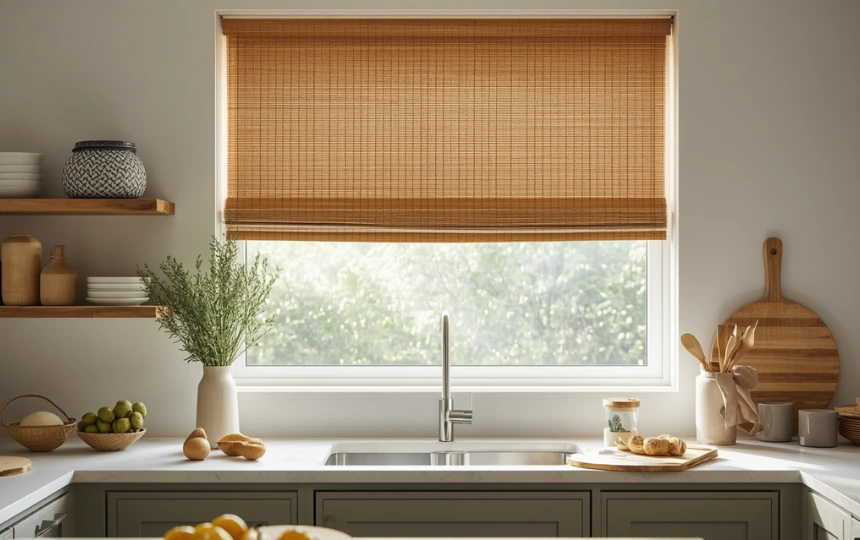
Woven bamboo and rattan blinds occupy a useful position between a curtain and a hard blind. They have the warmth and organic texture of a natural material while rolling or folding away cleanly when not needed.
The light that filters through a woven bamboo blind is one of the most beautiful effects available for a kitchen window. The small gaps in the weave create a dappled, warm pattern on the countertop and walls that changes as the sun moves. It is genuinely atmospheric in a way that fabric curtains and hard blinds cannot match.
They suit warm, organic, and Mediterranean-inspired kitchens particularly well. Natural bamboo tones in honey, wheat, and warm brown work alongside terracotta, sage, warm white, and wood-tone cabinetry. They are less at home in very sleek, contemporary kitchens where the natural texture can feel out of place.
The practical consideration: woven bamboo blinds filter but do not fully block light. For morning glare or privacy at night, a roller blind liner behind the woven blind is the solution. Many suppliers offer woven blinds with an optional blackout liner that deploys independently for full control.
Privacy Film: The Modern Curtain Alternative
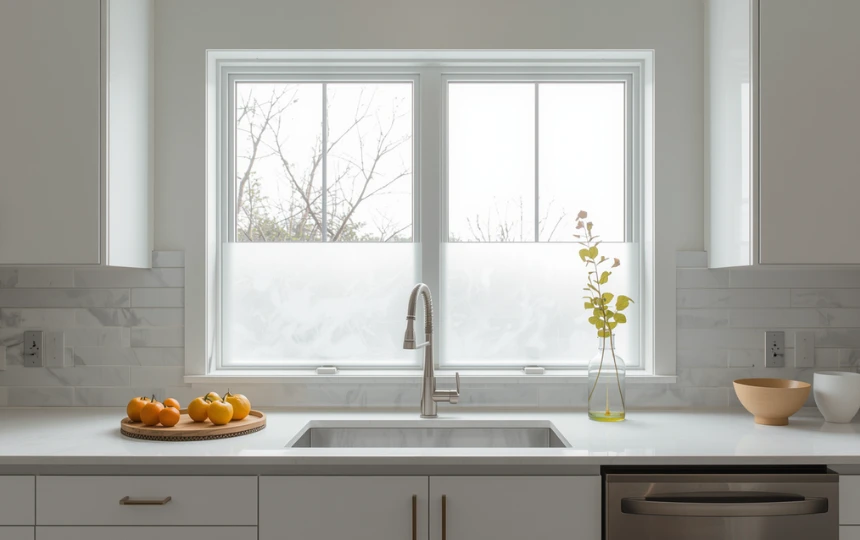
Privacy window film is the option that most curtain guides do not mention. For kitchens that need privacy at the lower portion of the window without any fabric, rod, or hardware, it is genuinely the cleanest solution available.
Frosted or etched-glass effect films applied to the lower half of the window achieve exactly what cafe curtains achieve, without the curtain. Light still enters through the frosted section. The view from outside is obscured. There is nothing to wash, nothing to rehang, and nothing to catch on cabinet doors or hardware.
The application is straightforward. The film is cut to size, soaked in water, and applied directly to the glass. It peels off without leaving residue when you want to remove it. Most quality films last five to ten years before the adhesive degrades.
This suits very minimalist and contemporary kitchens where any fabric treatment would interrupt the clean lines. It also suits rental kitchens where installing hardware on window frames is not permitted. The film looks like the glass was specified frosted from the factory, which is a genuinely good outcome for a relatively small investment.
Kitchen Curtain Fabric and Hanging Guide
Before You BuyThe two decisions that determine whether kitchen curtains look good are fabric choice and hanging method. Here is the straightforward version of both.
| Fabric | Light Control | Washable | Best Kitchen Style | Avoid If |
|---|---|---|---|---|
| Natural Linen | Filters softly | Yes (cold wash) | Warm modern, Japandi, Farmhouse | You need full blackout |
| Cotton | Depends on weight | Yes (easy care) | Any style | Near very high steam zones |
| Sheer Voile | Diffuses only | Yes (gentle cycle) | Scandi, airy contemporary | You need evening privacy |
| Woven Bamboo | Filters, dappled light | Spot clean only | Mediterranean, Organic | You need full light control |
| Cotton-Linen Blend | Medium filtering | Yes | Transitional, any warm kitchen | Very humid high-steam kitchens |
| Polyester | Variable | Yes (easy care) | Budget-conscious any style | You want natural texture and drape |
The Three Hanging Mistakes That Make Curtains Look Wrong
First: hanging the rod too low. The rod belongs 4 to 6 inches above the window frame, not on the frame itself. Second: using panels that are too narrow. Each panel should be at least 1.5 times the width of the window for proper fullness when closed. A panel that just covers the glass lies flat and looks like a sheet rather than a curtain. Third: stopping the curtain above the floor. If you are hanging floor-length curtains, they should touch or just exceed the floor. A gap between the curtain hem and the floor always looks like a mistake.
Start With What the Window Actually Needs
Before choosing a curtain style, be clear about what the window actually requires. Privacy only? Cafe curtains or privacy film. Light diffusion? Sheer linen. Full light control? Roman shade with liner. No requirement at all? No curtain.
Most kitchen curtain decisions go wrong when the curtain is chosen for appearance first and function second. Get the function right and the appearance choices become much simpler. A curtain that does its job well in the right fabric and the right length almost always looks good too.
Frequently Asked Questions About Kitchen Curtains
Natural linen cafe curtains are the most practical and most universally suitable choice for most kitchen windows. They balance light and privacy without blocking the kitchen’s natural light, handle the kitchen environment (moisture, cooking vapors) better than heavy fabrics, and look genuinely good in almost any kitchen style from farmhouse to contemporary. Flat Roman shades in a medium-weight linen are the best choice if you want a cleaner, more architectural look. Woven bamboo blinds are excellent for organic and Mediterranean-inspired kitchens.
It depends on the style you are going for. Floor-length curtains look best when they just touch or slightly puddle on the floor. A gap between the hem and the floor always looks like a measurement error rather than a design choice. However, not all kitchen curtains need to be floor-length. Cafe curtains cover only the lower portion of the window. Roman shades sit within the window recess. Sill-length curtains that hang to the windowsill are appropriate for smaller kitchen windows where floor-length would look disproportionate. Match the length to the scale of the window and the kitchen.
Natural linen and cotton-linen blends are the best fabrics for kitchen curtains. They are washable, handle kitchen humidity reasonably well, and have a warm, natural texture that suits most kitchen aesthetics. They also improve in appearance over time, which synthetic fabrics rarely do. Avoid velvet, heavy wool, and silk in kitchens. These fabrics absorb cooking odors, are difficult to clean, and are too formal for a kitchen environment. Always check the care label and choose a machine-washable option wherever possible.
Mount the curtain rod 4 to 6 inches above the window frame, not on the frame itself. Extending the rod 8 to 12 inches beyond the frame on each side allows the panels to sit completely off the glass when open, which maximizes light and makes the window appear larger. If you have high ceilings, mount the rod even higher. The closer the rod is to the ceiling, the taller the ceiling appears. This principle applies to kitchen curtains as much as to living room drapes.
Yes. Cafe curtains have a long history in kitchen design precisely because they solve the kitchen window problem elegantly. Privacy at the lower portion of the window where it is needed, open glass above where light matters most. The version that looks current in 2026 is natural, undyed linen on a simple brass or wooden rod rather than the country-cottage floral versions that preceded them. The format is timeless. The fabric and hardware determine whether the result feels current or dated.
No. Many modern kitchens look better without any window treatment at all. If your kitchen has adequate privacy from neighboring windows, a pleasant view, and good natural light, bare windows can be the right choice. Curtains should solve a problem: privacy, glare, light control, or visual warmth. If the window does not have any of those problems, adding a curtain for its own sake often makes the kitchen look more cluttered rather than more considered. Try living without window treatments for a few weeks before committing to anything.